Deutsch
 Français
 Espanol
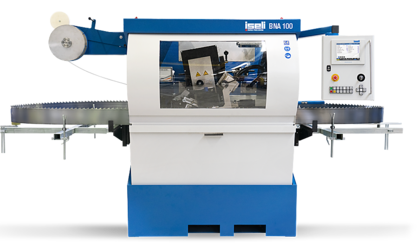
BAS 100
Fully automatic, hydraulically controlled swaging machine
for band and gang saw blades

Highlights
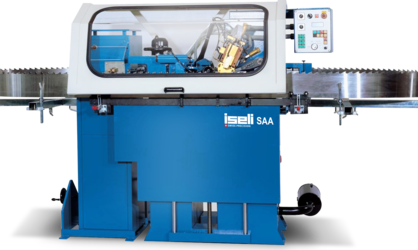
- The ISELI STA has a robust steel design. The machine is hydraulically controlled and equipped for band saws.
- The same tooth can be swaged once or twice and shaped in a single pass
- All the work processes are hydraulically controlled
- The blade feed is effected by the swage die so that accurate positioning of the saw tooth is guaranteed
- Swaging densifies the tooth point of the saw tooth of what results in a smoother and more accurate cut of the wood and a higher production
- By swaging, the tooth tip of the saw tooth is compressed, thus achieving a longer working life
- The swaging excenter is mounted on both sides and can be moved axially. It can be used in 10 different positions
- The clearance- and the rake angle, the width to be shaped and the tooth pitch are easily set according to scales, without changing any machinery parts
 Swaged Tooth
 Swaged Tooth Shaped
 Swaged Tooth Grinded
Technical data

| Tooth pitch: | 18 - 76 mm |
| Tooth height: | from 10 mm |
| Clearance angle: | 5 - 28° |
| Front rake angle: | 5° - 35° |
| Shaping fences-clearance angle: | 5 or 8° |
| Band saw blades | |
| Blade width standard: | 80 - 360 mm (standard) |
| from 50 mm (option) | |
| Blade length: | from 5'300 mm |
| Gang / frame saw blades | |
| Toothed length: | up to 1'500 mm |
| Blade width: | 75 - 180 mm |
| Working speed: | up to 6 t/min. |
| Power requirements: | 400V 3Ph N, 50Hz, 3,0kVA |
| Air connection: | 6 bar (only for automatic lubrication) |